
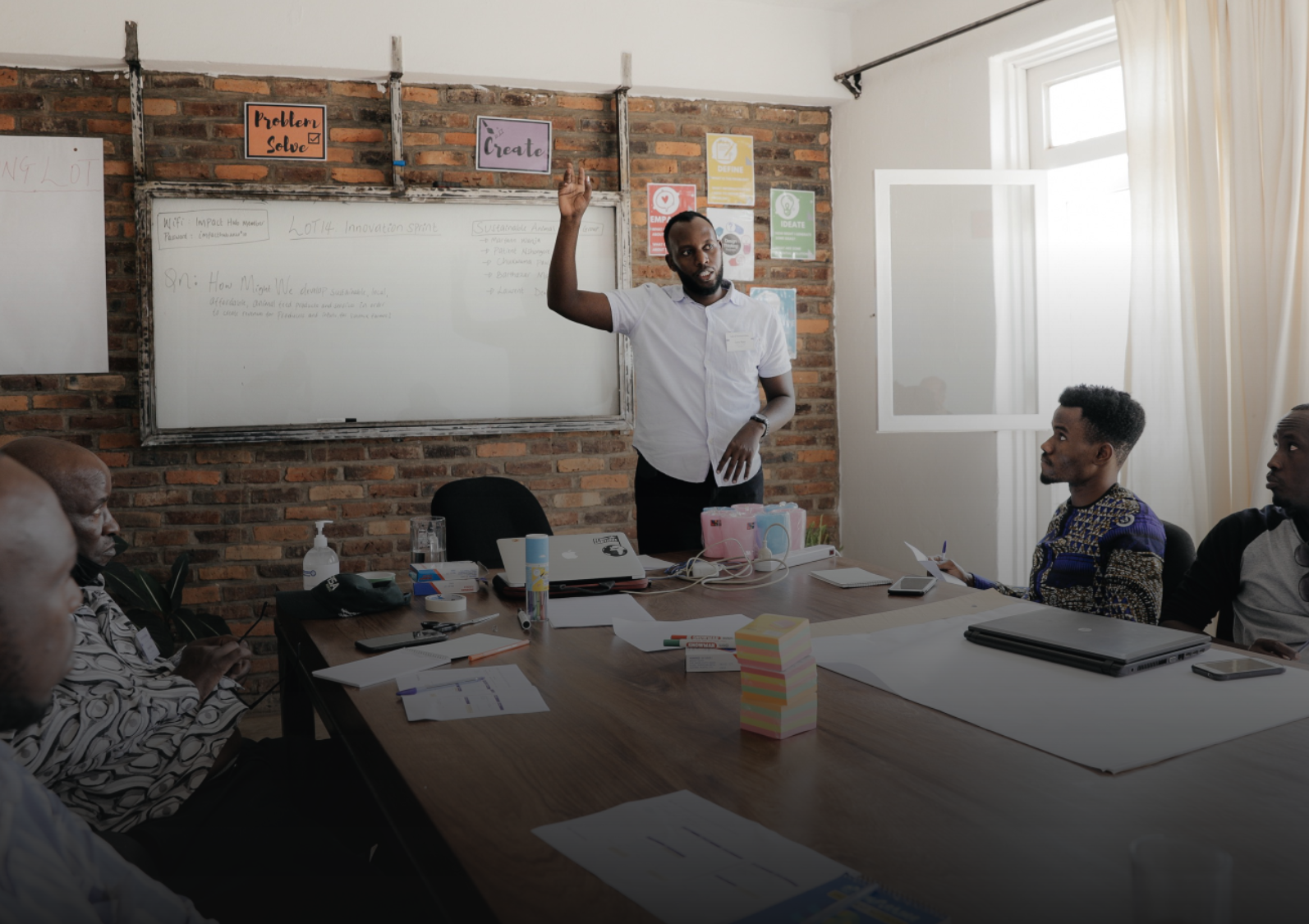
The lab of tomorrow (lot) is an open innovation process involving multiple stakeholders to develop entrepreneurial solutions to global challenges and thus also an incubator for impact-oriented business activities and cross-sector partnerships. By bringing together people with diverse backgrounds and expertise and jointly developing new solutions to the grand challenges of our time, lot holds enormous potential for positive social change. The goal of the project is to promote the co-creation of social innovations that contribute to the achievement of the SDGs and systemic change.
The lot format was developed by the Deutsche Gesellschaft für Internationale Zusammenarbeit (GIZ) on behalf of the German Federal Ministry for Economic Cooperation and Development (BMZ) and has proven its worth with eleven completed processes and over 50 business model outlines created, many of which have been implemented.
lab of tomorrow #14 Promoting the circular economy in Rwanda
With lab of tomorrow #14, CSI-HSG in collaboration with the Swiss Agency for Development and Cooperation (SDC) co-initiated the first edition of the lot for the Swiss development context. The lot 14 addresses the challenges related to the food system in Rwanda. Based on in-depth research and needs assessments, people from different sectors and backgrounds collaborated to develop innovative solutions through an innovation sprint based on design thinking. During the incubation phase, the teams received coaching to further develop their solutions so that they could eventually be implemented and have an impact. CSI-HSG is implementing the project in collaboration with several partners, including SDC, GIZ, Nestlé, Impact Hub Kigali and reverse.
The Challenge
Malnutrition, limited access to affordable and nutritious food, insufficient agricultural productivity, and high post-harvest losses are among the most pressing development challenges in East Africa. These problems are systemic: they involve soil health, supply chains, market access, consumer behavior, and policy. None of them can be addressed in isolation, and none by a single organization or sector alone.
The Process
Lab of Tomorrow 14 was the first edition of the LOT format adapted for the Swiss development context, co-initiated by CLIS-HSG and the Swiss Agency for Development and Cooperation (SDC) with support from GIZ, Nestlé, and the Hirschmann Foundation. The challenge: developing entrepreneurial solutions for a circular food system in Rwanda.
The process followed the established LOT methodology across three phases. In the first phase — understand — CLIS-HSG and its local implementing partner Impact Hub Kigali conducted extensive field and desk research in Rwanda, framing the overarching challenge into specific sub-challenges through workshops with local stakeholders from the private and public sector, academia, and civil society. Five sub-challenge areas with high innovation potential were identified: animal feed quality for smallholder livestock farmers, access to fresh produce for urban consumers, food waste management, post-harvest losses in smallholder supply chains, and circular economy models for agricultural by-products.
In the second phase — innovate — a multistakeholder innovation sprint brought together 36 participants from 30 organizations in a hybrid format, combining in-person teams in Kigali with online participants. Using design thinking methods, cross-sector teams moved from shared problem understanding through ideation and prototyping to the development of initial business model sketches. Each team was supported by an experienced design thinking coach.
In the third phase — incubate — the most promising teams received financial and non-financial support over two incubation phases, including bi-weekly coaching, access to experts, and tailored training. Teams refined their prototypes, tested them in the field, and developed their solutions toward market readiness.
The Outcomes
Three ventures emerged from the process, each addressing a different element of the circular food system challenge:
Impact
Across the three ventures, LOT 14 generated measurable results: 1,700 tonnes of animal feed produced, 2,200 tonnes of waste reused, 2 stores opened, 15 jobs created, and increased income for participating farmers. Beyond these direct outputs, the process strengthened the social entrepreneurial ecosystem in Kigali, raised awareness of circular food systems in Rwanda, and contributed to building a community of practice around circular economy at Impact Hub Kigali.
The process also generated academic insights on multi-stakeholder co-creation dynamics in development contexts, feeding directly into CLIS-HSG's Mission-Based Ecosystem Lab research program. Six key success factors were documented in a public learning report: building participatory infrastructure, focusing on good facilitation and learning, steering for impact, crafting actionable challenges, designing fruitful spaces for co-creation, and providing supportive incubation environments.
Partners
LOT 14 was co-initiated by CLIS-HSG and SDC, with GIZ providing methodological support as the original developer of the LOT format. Impact Hub Kigali served as local implementing partner. Additional support came from Nestlé, the Hirschmann Foundation, the City of Kigali, and reverse AG as design facilitation partner.