Partnership Catalyst

Building bridges between innovation ecosystems to solve shared challenges through strategic cross-border collaboration.

The Partnership Catalyst is a structured program that brings together companies from different countries and innovation contexts to co-create digital or product solutions that neither partner could develop alone. It is a proven methodology for creating mutual value: local partners bring deep contextual knowledge and market access; international partners contribute technical capabilities, scalability know-how, and global networks.

The Partnership Catalyst Methodology

  1. Landscape Study: An in-depth research phase maps the challenge landscape, identifies key sectors with high impact potential, and profiles the ecosystem of relevant companies in both partner countries.
  2. Selection Process: A structured, transparent selection process identifies companies on both sides based on complementary capabilities, shared values, and strategic alignment. Selection criteria are made public.
  3. Strategic Matchmaking: Each local company is matched with one international partner based on complementary strengths—not just similarity—and potential for a genuine 1+1=3 value creation dynamic.
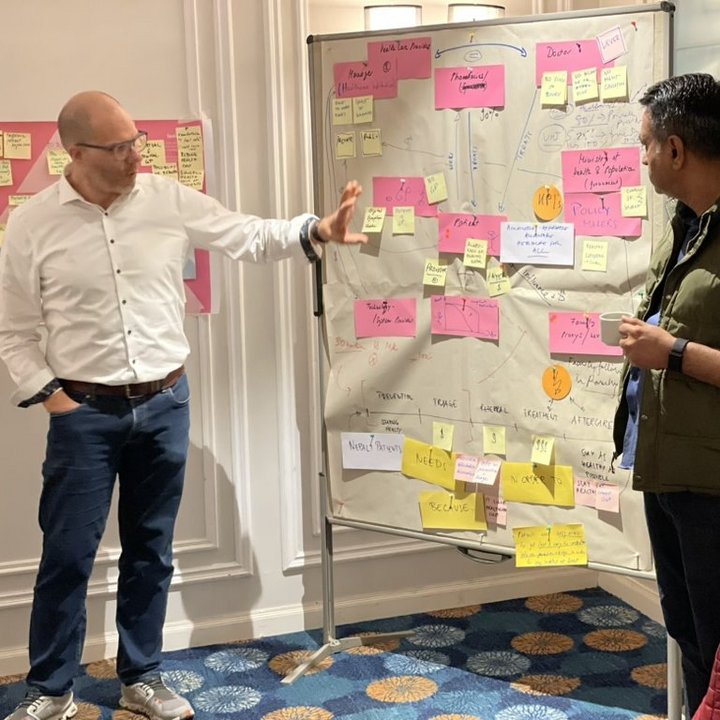
  4. Co-Creation Workshop (3–4 days): An intensive in-person workshop in the partner country where matched companies develop joint solutions. Facilitated by CLIS-HSG using design thinking and structured collaboration methods. The location choice—in the partner country—is intentional: it ensures local partners are not disadvantaged by unfamiliar settings.
  5. Bilateral Support (3–6 months): After the workshop, CLIS-HSG provides ongoing support through bilateral check-ins with each partnership. This phase is where most partnerships encounter their first real challenges—and where facilitated support makes the difference.
  6. Hybrid Sprint: After the piloting phase, partnerships reconvene for a shorter sprint session to address challenges that have emerged and refine solutions based on evidence from real-world testing.

Why it works:

  • It solves the cold-start problem: companies lack the networks, trust, and process knowledge to form these partnerships independently
  • Structured matchmaking based on complementarity, not similarity, creates more innovative and resilient partnerships
  • In-country facilitation ensures local partners operate with equal standing from the start
  • Sustained post-workshop support significantly increases the probability that partnerships survive the transition from idea to implementation


Case Study: DIGI Nepal Partnership Catalyst (2024 - 2025)

Program Context

Nepal’s unique topography creates structural barriers to economic development: steep terrain, limited road infrastructure, and geographic isolation make it expensive and difficult to deliver services to communities outside Kathmandu. Digital technology offers an opportunity to leapfrog physical infrastructure—but only if solutions are designed for Nepali realities, not imported from high-income contexts.

The Partnership Catalyst in Nepal was developed as a key component of DIGI Nepal, an SDC-led initiative aimed at fostering digital innovation to improve access to affordable basic services for discriminated groups and communities outside the capital. The hypothesis: combining Swiss technical expertise with Nepali contextual knowledge and market access could produce digital solutions with real reach.

PHASE 1: LANDSCAPE STUDY
Building on an SDC-commissioned landscape study of Nepal’s digital innovation ecosystem, the SDC identified three sectors with high impact potential and strong conditions for cross-border partnership:

  • Fintech: Nepal has a large unbanked and underbanked population, particularly in rural areas. Mobile and digital financial services are growing rapidly but face challenges of trust, connectivity, and regulatory complexity.
  • Healthcare: Geographic isolation means many communities have limited access to medical services. Digital platforms for remote consultation, patient management, and health information have significant potential but require local language, trust, and last-mile distribution capabilities.
  • Food-Related Logistics: Agricultural supply chains are fragmented, with high post-harvest losses and limited market information for smallholder farmers. Data-driven supply chain optimization could reduce waste and increase farmer incomes.

PHASE 2: SELECTION AND MATCHMAKING
A structured selection process created conversations with over 50 Swiss and Nepali companies. Evaluation criteria included: technical capabilities, impact orientation, openness to collaboration, and complementarity with potential partners. Three partnerships were formed:

SectorNepali PartnerSwiss PartnerJoint Solution Focus
FintechAria TechnologiesAlvra LabsDigital payment infrastructure and financial services for underbanked communities in remote areas
HealthcareHealth at Home heyPatientIntegrated platform for remote patient monitoring, teleconsultation, and health record management
Food-related LogisticsNAXAAgriCircleData-driven platform connecting smallholder farmers to buyers, reducing information asymmetry and post-harvest losses

PHASE 3: THE CO-CREATION WORKSHOP

  • Dates: February 3–6, 2025
  • Location: Kathmandu, Nepal
  • Facilitation: Dino Darmonski and Dr. Justus von Grone, CLIS-HSG

The four-day workshop brought all three partnerships together in Kathmandu. The in-country setting was deliberate: it put Nepali partners on home territory, enabled site visits to real user contexts, and ensured that solutions were designed with Nepali realities—not European assumptions—as the starting point.

What made it work?

  • Complementary expertise: Nepali partners brought local knowledge, language, community trust, and regulatory understanding; Swiss partners contributed technical depth, scalability experience, and access to European funding
  • Structured process: The four-day arc provided a common methodology, reducing the ambiguity that often derails early-stage partnerships
  • Shared purpose: All participants were united by a genuine commitment to improving digital access for underserved communities
  • n-person, in-country: Physical presence in Kathmandu built relational trust that is difficult to replicate through video


Get in touch!

Dino Darmonski

M.A.

Project Manager & PhD Candidate

CSI-HSG
Müller-Friedberg-Strasse 6/8

9000 St. Gallen
north